
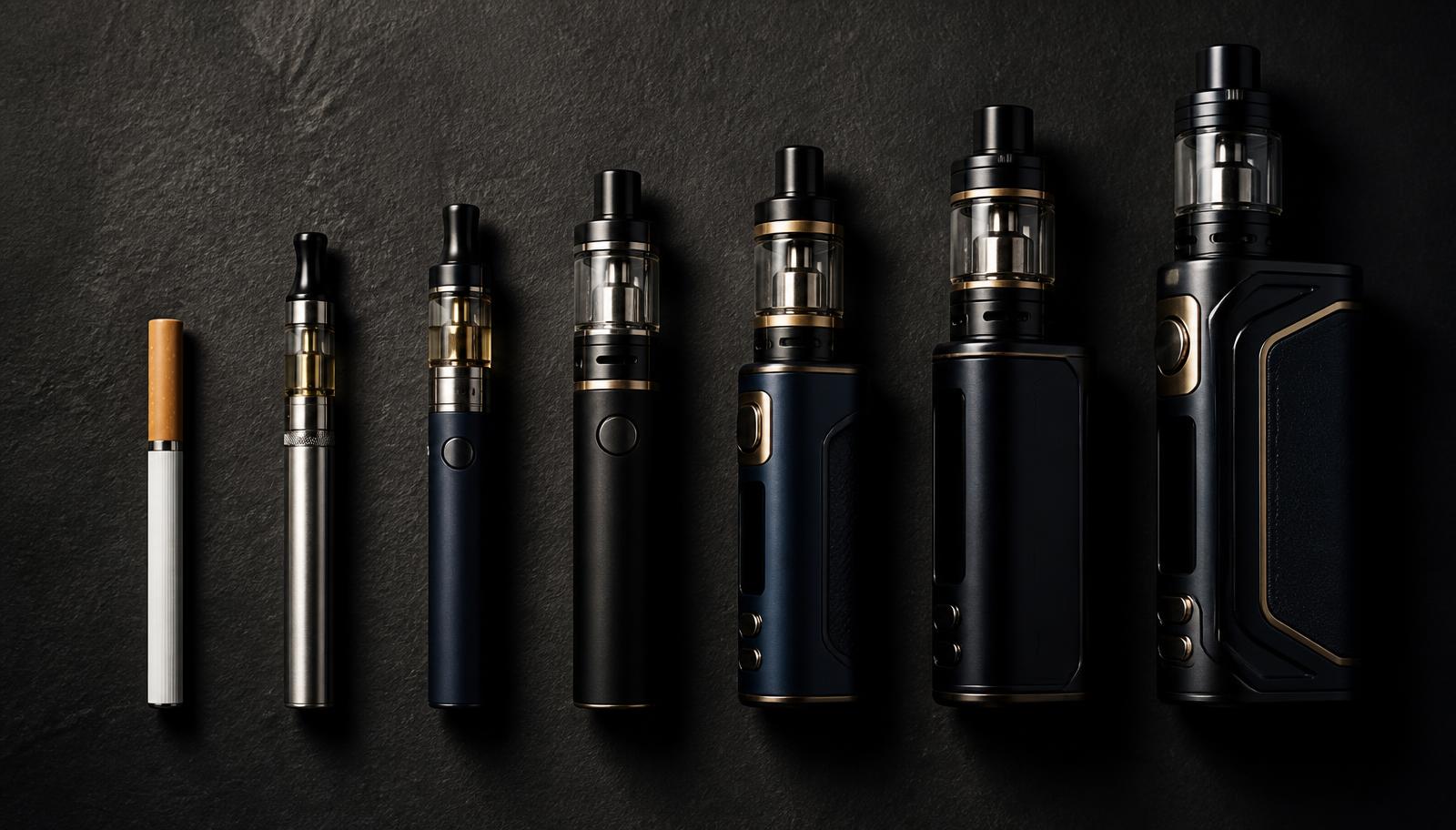
Vaping feels like a very modern invention — but the idea is much older than most people realise. The story is a mix of quiet inventors, patents ahead of their time, and one man's very personal reason for wanting an alternative to cigarettes.
The 1960s: a patent ahead of its time
The first known patent for a "smokeless non-tobacco cigarette" was filed in 1963 by an American inventor called Herbert A. Gilbert. His design used heated, moist, flavoured air rather than smoke. It worked — but the world wasn't ready. Smoking was still fashionable, health warnings were only beginning to appear, and no manufacturer took him up on the idea. His patent quietly expired.
The 2000s: the modern e-cigarette
The vape as we know it today was invented in 2003 by Hon Lik, a Chinese pharmacist whose father had died of lung cancer after decades of heavy smoking. Hon Lik was himself a smoker, and he set out to design a device that could deliver nicotine without the tar and combustion products of a cigarette. His breakthrough was to use a piezoelectric ultrasound element — later refined into a resistance wire coil — to vaporise a nicotine-containing liquid.
His employer, Golden Dragon Holdings, launched the device in China in 2004 and later rebranded to Ruyan, meaning "like smoke." Within a couple of years, e-cigarettes were being exported worldwide.
The 2010s: an industry emerges
Once vaping arrived in Europe and Spain, the pace of change was rapid. Early "cigalikes" that mimicked the look and size of a cigarette gave way to refillable "tank" systems, then to variable-wattage mods that put dozens of settings in the user's hands. The variety of e-liquids exploded from a handful of tobacco and menthol flavours to thousands of dessert, fruit and drink profiles.
Today: choice, refinement and regulation
Modern vaping is defined less by novelty and more by refinement — better batteries, smarter airflow, cleaner flavour, more sensible regulation, and a growing focus on responsible retailing. That's the approach we take in Moraira: a hand-picked range we've tested ourselves rather than every device on the market.
Not bad, for an idea that started with a grieving pharmacist and a forgotten American patent from 1963.